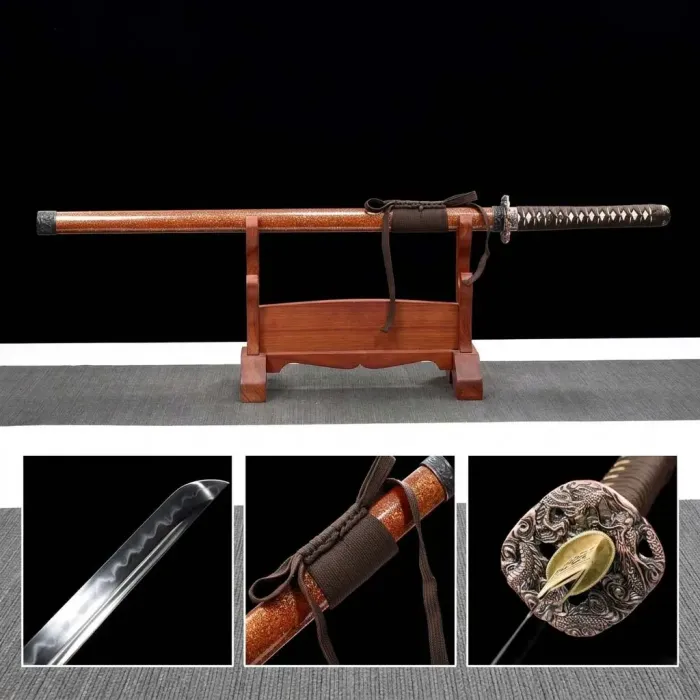
Such customary ancient blade remains a remarkable work of art, but say you want to convey your personal design? Modifying your instrument is a meaningful journey, allowing you to fashion a truly distinctive piece. From the grasp wrapping and fitting to the barrier design and blade pattern, each detail offers a chance for bespoke design. This exploration delves into the sphere of katana refinements, providing guidance for both learners and seasoned enthusiasts aiming to form their legacy on the long-standing art of the samurai.
1060 Steel Katanas: The Beginner's Real Skill
For those hoping to embark on the enriching journey of traditional blade practices , 1060 steel katanas supply an remarkable entry point. This specific grade of tool steel balances a suitable blend between price and capability . While not reaching hard as higher-end steels, 1060 enables a workable level of knife work , making it suited for initiates to practice the core principles of edge management and embrace the refinement of expertly made Japanese weaponry. It’s a fantastic choice for developing experience without the investment burden of more specialized steels.
Type T10 Edges : Managing Efficiency and Budget
Enabling connoisseurs seeking an authentic cutlass experience without overpowering the cash reserve , T10 substance katanas represent a beneficial option. These daggers offer a substantial improvement in durability compared to middling alternatives, exhibiting reasonable edge retention and fair flexibility for initial hacking techniques. While not rivaling the excellent characteristics of advanced steels like T100 or folded material , T10 provides a worthwhile blend of performance and value , making them a well-liked choice for trainees and those on a controlled revenue .
Surpassing the Edge : Customizing Your Weapon's Accessories and Hilt
Even though the polished metallic edge is undeniably the core point of a katana, truly enhancing its beauty lies in the detailed customization of its accessories and handle . This process allows craftsmen to reveal their personal approach . Contemplate the expansive possibilities: menuki - decorative trinkets that provide visual allure ; the hamon casings – often finely fashioned ; the tsuka body itself, wrapped in orthodox ito cord ; and the fusa pommel , which can be fabricated from various substances like treasures or antler .
- Prefer concepts that echo with you.
- Explore with different ingredients .
- Prioritize superiority for a lasting mark .
The Magnetism of the Katana: Background, Fabrication, and Iron
Every samurai blade features a special allure, steeped in periods of Pacific Rim history and heritage . More than merely a artificial item of warfare , it's a icon of the soldier ethos – a fusion of skill and regulation . Its maturation spanned score generations, with early steel evolving into the polished curvature and effective edge we acknowledge today. The fabrication involved is truly phenomenal , requiring epochs of training to conquer . The process involves a elaborate folding of metal bloom, creating layers that improve the weapon’s flexibility and hacking ability. Assorted schools of forging emerged , each with their specific secrets and procedures for achieving the exceptional steadiness and sharpness - a truly arduous pursuit.
- Primary Katana varieties
- The part of the historical weapon in champion culture
- Established smithing processes
Deciding the Best Steel for Your Bladed Weapon Project: 1060 vs. T10
Opting for the ideal steel is crucially important for any oriental blade project, and the resolution between 1060 and T10 can be delicate. 1060 is a well-known American composition, offering a solid balance of firmness and endurance, supplying it reasonably easy to forge. However, T10, a Oriental steel, frequently boasts increased wear durability and can arguably achieve a more ultimate hardness, although it can be somewhat difficult to apply and requires detailed heat forging. Consider your capability and targeted characteristics: for a newcomer, 1060 may be a more origin, while the competent smith might value the enhanced qualities of T10.
- Ease of Operating
- Resistance
- Definitive Durability
Revealing the Strength: Expert Katana Improvement Strategies
Honing the expertise in edge enhancement extends far beyond basic polishing. Serious professionals are now examining advanced techniques to truly unlock a blade's hidden potential. This comprises intricate work with the quenching mark, utilizing specialized materials for differential processing and carefully picking the geometry of the shield to optimize balance and effectiveness. Beyond purely functional enhancements, artisans are increasingly focused on reaching unparalleled aesthetic beauty, through complex cutting and layered surfaces that truly transform a katana into a exquisite object.
Forging a 1060 Katana: From Raw Metal to Masterpiece
The journey opens with ordinary 1060 compound , a tough material far separated the refined katana it will turn into . Skilled bladesmiths practice a complex process of integrating and constructing the unrefined steel, repeatedly glowing it and beating it to rid impurities and produce a homogeneous grain structure. This tedious process, often continuing for spans , builds the vital sturdiness and ductility characteristic of a authentic Japanese cutlery . Further heat procedures , including deliberate hardening and tempering , are essential to achieve the targeted balance of 1060 steel katana sharpness, life and loveliness .- Uniting: Removes impurities and develops grain structure.
- Forming: Fabricates the steel into the initial blade form.
- Tempering: Decides the final hardness and flexibility.
The Persistent Magnetism of the Katana: Thorough Examination of Alloy and Modification
That time-honored katana lasts a powerful symbol for Japanese tradition , its attraction far overtopping mere arms and armor . Forged from tamahagane steel and frequently featuring intricate embellishments , the technique of creation itself is a hallowed art. Beyond the crucial craftsmanship, the ability to adapt a katana - from the temperation to the hold wrapping and sheath - facilitates for a truly individual expression for both collectors and users alike. This blend of time-honored steelwork and boundless personalization results in the katana's continued prominence across the planet .
